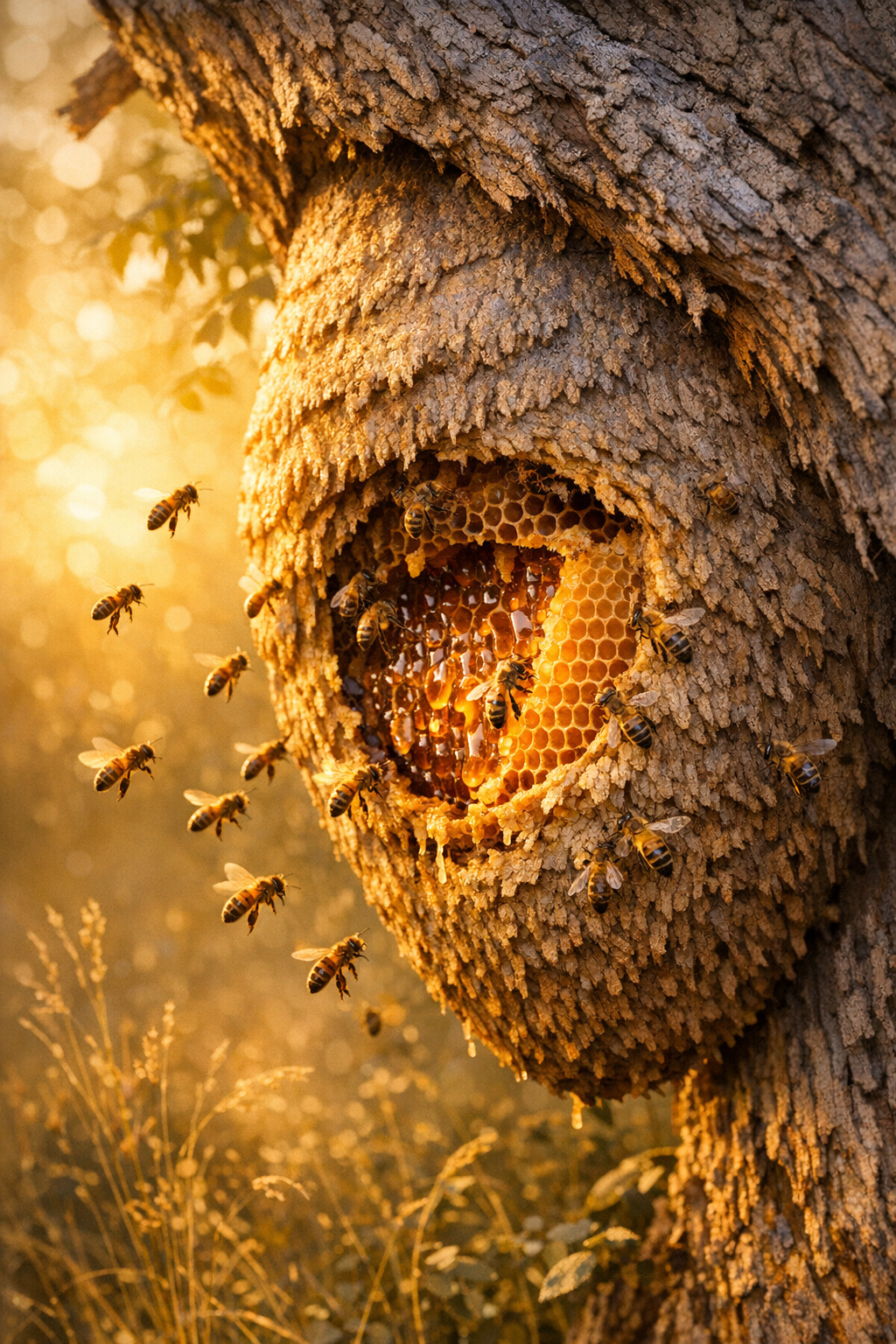
They were here long before the garden. They will remain long after.
The hive lives by its own rhythm. It does not belong to the garden, nor to the hearth. It was here before planted borders and stone paths, and it will remain long after flowers fade and seasons turn.
In spring, it feeds on elderflower and hawthorn. In summer, on clover, wild rose, and whatever the meadow offers freely. In autumn, it draws inward, storing light in amber cells and sealing sweetness for leaner days.
The hive gives more than honey. It gives wax for candles and salves, quiet industry, and a reminder that some of the best work in the world is small, steady, and shared.
The wild hive is not harvested greedily. What is taken is taken lightly, and only when there is more than enough.
Raw honey is best treated gently. Many people prefer not to overheat it, as warmth can reduce some of its naturally occurring enzymes and other delicate qualities. Brief contact with a spoon is usually considered fine; it is heavy heat and rough handling that matter more.
Stir into tea only when it has cooled a little. Spoon over bread, porridge, or fruit. Use it where its scent and character can still be noticed.
Beeswax keeps the memory of warmth. It can be turned into candles, used in simple salves, or melted into balms with herb-infused oils.
Honey is best used where its warmth and character can still be tasted. These are small, simple ways to bring it into daily life.
Keep it simple. Let the honey be the flavour, not just the sweetness.
Honey can be gently infused with herbs and flowers, creating something both beautiful and useful.
Add dried herbs or petals to a jar of honey and leave for 1–2 weeks. Strain if preferred, or leave as it is.
Beeswax burns slowly, with a soft golden light and a gentle, natural scent. It is one of the simplest and most satisfying things to make.
A beeswax candle carries warmth into a room — steady, quiet, and lasting.
A basic balm can be made with just two ingredients — beeswax and oil.
Melt together gently, then pour into small jars and allow to set.
Use on dry hands, lips, or anywhere needing a little extra care.
The hive gives more than we expect — if we take the time to notice.
Honey is not taken. It is given — when there is enough.
Leave plenty. Move gently. Let the hive remain a living thing, not merely a storehouse.
What the hive offers is not only sweetness, but a way of working — quiet, patient, and shared.